
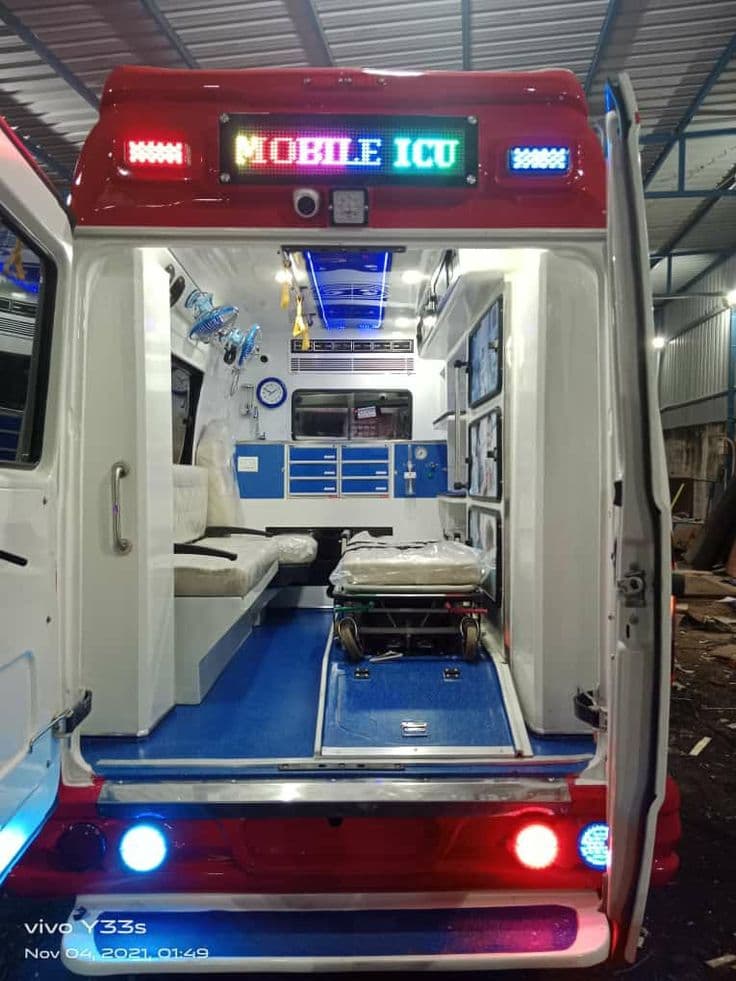
Not every critical patient needs a ventilator, and not every ICU ambulance is actually equipped to run one continuously during transport. A ventilator ambulance is a specific category built around one requirement: keeping a patient breathing safely and consistently while they're moved.
What makes a ventilator ambulance different
A standard ICU ambulance carries monitoring and oxygen support, but a ventilator ambulance is purpose-built and staffed around the added complexity of continuous mechanical ventilation — settings need to be watched, tubing needs to stay secure through vehicle movement, and the crew needs to be ready to respond immediately if anything changes.
- A transport ventilator with battery backup, separate from the hospital's fixed unit
- Continuous oxygen supply sized for the length of the journey, with reserve capacity
- Cardiac and oxygen-saturation monitoring throughout transit
- A paramedic trained specifically in managing ventilated patients in a moving vehicle, not just general critical care
Who typically needs a ventilator ambulance
- Patients already on a ventilator being transferred between hospitals or ICUs
- Patients being discharged home on long-term ventilator support
- Severe respiratory failure cases requiring continuous assisted breathing during transport
- Post-surgical patients who haven't yet been weaned off ventilation
What to tell us when booking
If you know the patient is currently on a ventilator, say so when you call — this is one of the details that changes which vehicle and crew get assigned, so mentioning it upfront avoids delays from re-dispatching a different unit. It also helps to know the current ventilator settings or have the treating doctor available to brief our paramedic during handoff.
Inter-hospital transfers are the most common use case
Most ventilator ambulance calls we handle are planned inter-hospital transfers rather than first-response emergencies — moving a patient from a general hospital to a facility with a specialized ICU, for example. Because these are usually scheduled rather than sudden, there's time to confirm equipment compatibility and brief the crew properly before the transfer begins.
Related questions
Yes, typically — the specialized equipment and additional trained staffing involved mean higher cost than a standard ICU or BLS vehicle. Our coordinator will confirm exact pricing based on the specific transfer before dispatch.
On this page
Related services
Need an ambulance now?
Our team is available 24×7 for emergency dispatch and scheduled transport across Hyderabad.